You have been told your PSA is high and you want to know what it means. It is a common finding and does not mean you have cancer. Here I explain what the test measures, why it can rise, how to repeat it properly and what steps usually follow.
Reviewed by Dr. Mario Domínguez Esteban, urologist (medical licence no. 392860199). Head of the Uro-Oncology Section, Marqués de Valdecilla University Hospital.Last reviewed: · Next review: Oct 2027
What PSA is
PSA (prostate-specific antigen) is a protein made by the prostate. It makes semen more fluid. Almost all PSA stays in the semen, but a small amount passes into the blood, and that is what the test measures.
Over the years the prostate grows, so it is normal for PSA to rise slowly with age. A high value means it is worth looking more closely, but on its own it does not tell what is happening.
Having the test is your decision, and there is no right answer for everyone. From the age of 50 you can discuss it with your doctor. If there has been prostate cancer in your family, if you are of African or Caribbean descent or if you carry a BRCA2 gene mutation, it may make sense to start earlier: your doctor will help you decide when.
Why it can rise
PSA can rise for reasons that have nothing to do with cancer. The most common ones are these:
Benign prostatic enlargement (BPH), which is very common with age. If it also causes urinary symptoms, in HoLEP I explain one of the treatment options.
Inflammation or infection of the prostate (prostatitis) or of the urine, especially if there has been a fever. After an infection, PSA can take months to come down.
Urinary retention, a catheter or a recent biopsy.
Ejaculating, intense cycling or having your prostate examined in the days before the test.
Sometimes, prostate cancer. That is why it is investigated.
The opposite also happens: a PSA within the expected range does not completely rule out cancer. That is why PSA is never interpreted on its own, but together with other data.
Before repeating the test
A single high value is not enough to make decisions. The test is usually repeated a few weeks later. For a reliable result:
In the 2–3 days beforehand, avoid ejaculation, intense cycling and similar activities: they can cause a false positive.
If you have had a fever or a urine infection, tell your doctor: it is worth waiting. The European Association of Urology (EAU) patient information mentions at least 6 weeks after a urine infection.
After a biopsy, PSA is repeated at least one month later.
If you take finasteride or dutasteride, mention it: they lower PSA by roughly half.
Bring a list of the medicines and supplements you take, in case any of them affects the result.
Have your tests at the same laboratory and prepare the same way each time. That way the results can be compared.
What does my number mean?
There is no PSA value that separates normal from abnormal for everyone. The same value does not mean the same at 50 as at 75, or in a small prostate as in a large one. More than the number on its own, the whole picture matters:
Your age.
The size of your prostate. The ratio between PSA and prostate volume is called PSA density, and it helps interpret the value.
How it has changed compared with your previous tests. Several tests over time say more than one.
The rectal examination, your family history and whether you take any medication that changes PSA.
If you are wondering about a specific number, such as 4, 5 or 6 ng/ml, the answer depends on all of the above. Your doctor will interpret it with you.
What comes next
If your PSA is still high when repeated, these are the usual steps. Not everyone goes through all of them:
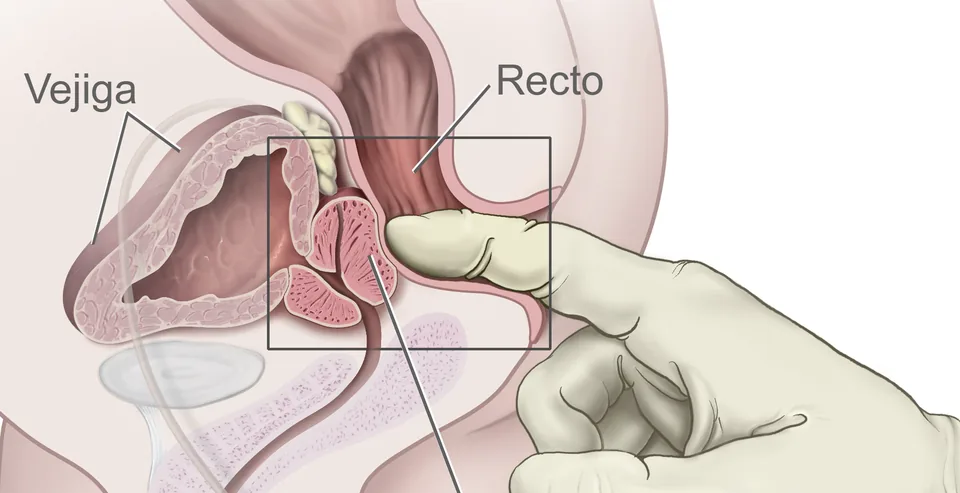
Rectal examination. Your doctor examines the prostate with a finger through the rectum. It is quick, may feel a little uncomfortable and gives information the blood test does not.
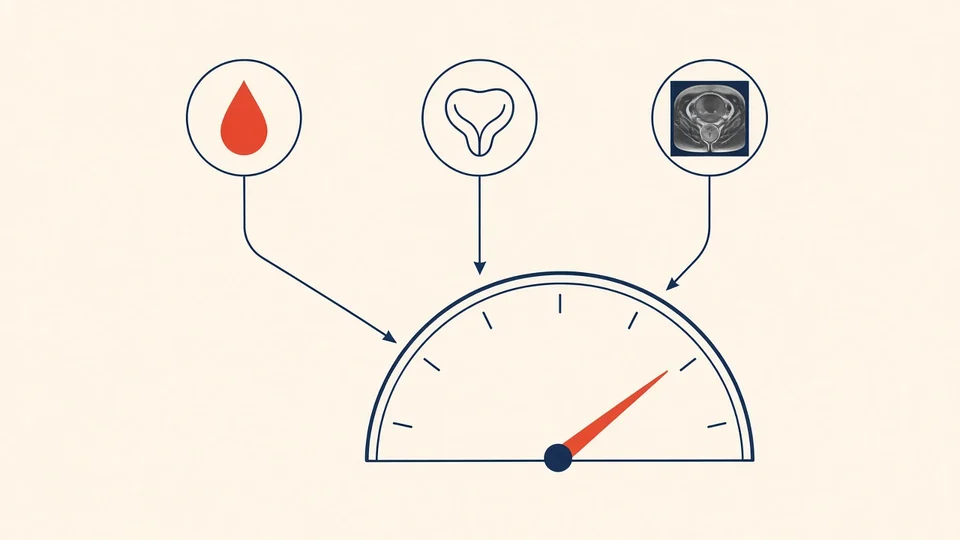
Risk calculator. It combines your data (age, PSA, rectal examination, prostate size and, if available, the MRI) to estimate the risk.
Biomarkers. In some cases an additional blood or urine test, such as PHI, helps. The European guidelines consider that their usefulness is still being confirmed.
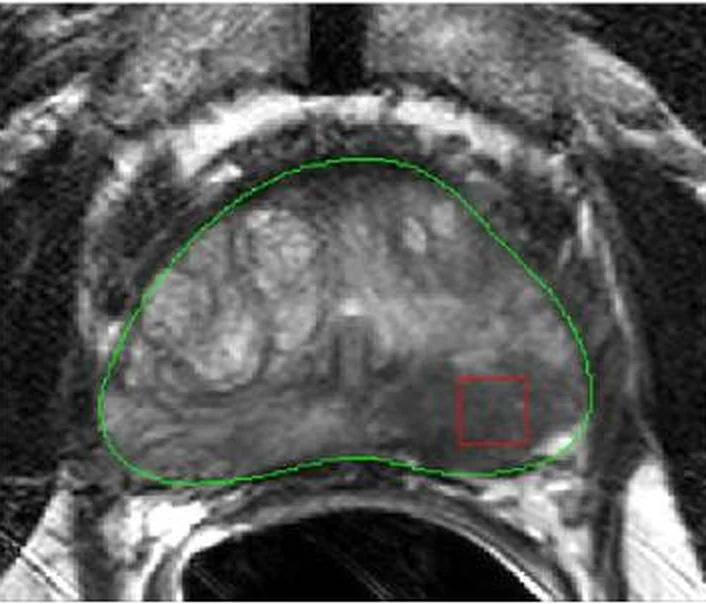
Prostate MRI. It looks for suspicious areas and helps decide whether a biopsy is needed and, if so, where to take the samples. What it shows is graded with the PI-RADS scale, which I explain on the fusion biopsy page.
MRI and risk calculators have been shown to help decide whether a biopsy is needed more accurately than PSA or rectal examination alone. This avoids unnecessary biopsies while still detecting the cancers that matter.
On the role of artificial intelligence in reading prostate MRI, there is a clinical reading in AI in prostate MRI.
The raised PSA pathway
This is the full pathway, step by step, with images:
Visual pathway · 6 steps
Raised PSA pathway
What usually happens after a raised PSA, step by step. Not everyone goes through every step.
Original illustration
Step 1
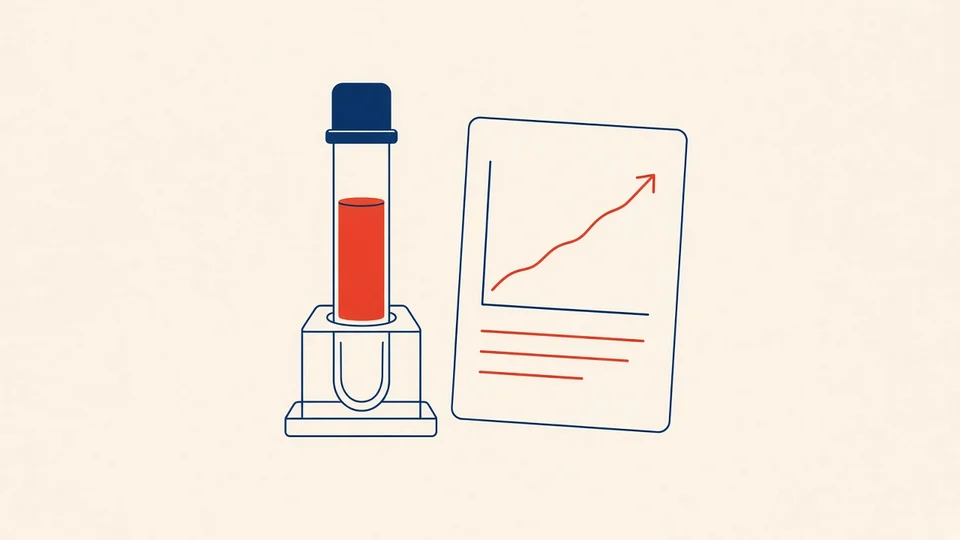
PSA test
Blood test
A blood test measures PSA. A high value is a signal to look further, not a diagnosis.
The test is repeated, preferably in the same laboratory, to confirm it is still high. For 2–3 days beforehand, avoid ejaculation and intense cycling. Your doctor may also examine your prostate with a digital rectal examination: it is quick and provides information.
Steps 3 and 4: the order can vary. Biomarkers and risk calculators can be used before the MRI, after it or at both points.
Original illustration
Step 3
Biomarkers and risk calculators
Before or after the MRI
A biomarker is an additional blood or urine test, such as PHI. A risk calculator combines your data (age, PSA, rectal examination, prostate size and, if available, the MRI) to estimate the risk.
It looks for suspicious areas in the prostate. It helps decide whether a biopsy is needed and, if so, where to take the samples. Its result can be added to a risk calculator.
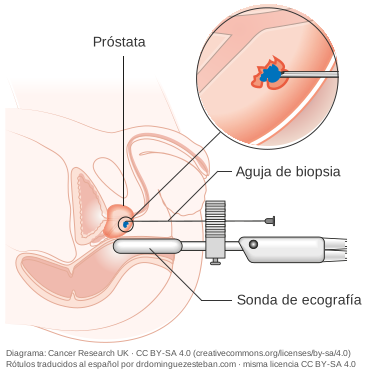
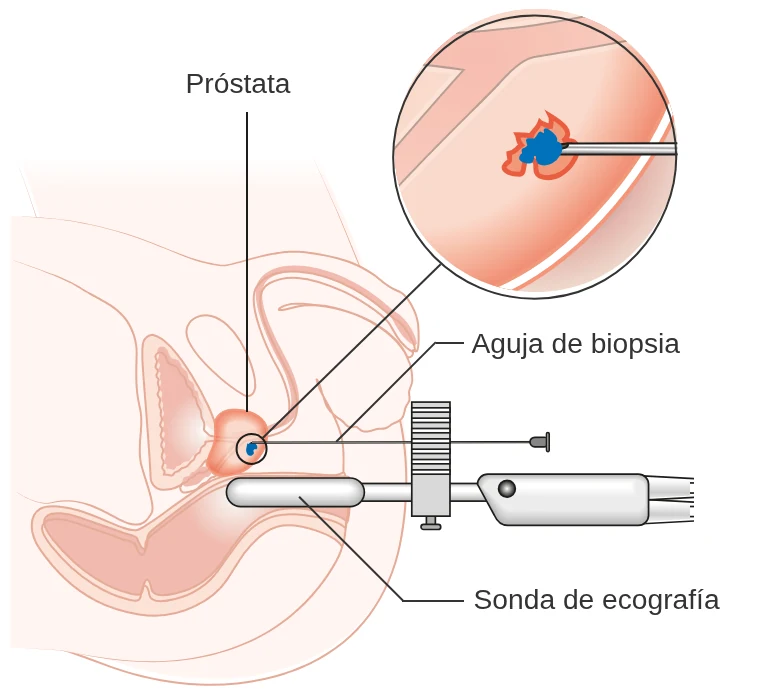
The MRI is combined with ultrasound, which may be high-resolution micro-ultrasound, to guide the samples to the suspicious area. This improves detection of cancers that need treatment. The transperineal route, through the skin of the perineum, carries a lower risk of urinary infection. It is the option in line with the European guidelines.
With the results, you and your urologist decide on the next steps: follow-up with further tests, more investigations or treatment. Bring your questions written down.
Why combine steps?
MRI and risk calculators, including those that incorporate the MRI result, have been shown to improve the decision on whether to perform a biopsy compared with PSA or rectal examination alone. They help avoid unnecessary biopsies while still detecting the cancers that matter.
Biomarkers such as PHI may help in some cases. The European guidelines consider that their value is still being confirmed.
Original illustrations generated with AI and reviewed by Dr. Domínguez Esteban.
High PSA with a negative biopsy
A biopsy that finds no cancer is good news. But if PSA remains high, it does not always settle the matter: a biopsy does not reach every area of the prostate.
The usual approach is to continue with PSA check-ups. Depending on your case, your urologist may suggest repeating the MRI, using a risk calculator or a biomarker and, if the suspicion continues, considering a new biopsy targeted at the suspicious areas. If your first biopsy was done without a prior MRI, you will probably be offered one.
PSA after treatment
If you have been treated for prostate cancer, PSA becomes the main follow-up tool, and it is interpreted differently:
After removal of the prostate (radical prostatectomy), PSA is expected to fall until it is undetectable. If it becomes detectable again at check-ups and rises, your urologist will assess whether further tests are needed.
After radiotherapy, the prostate is still there, so PSA falls more slowly and does not usually reach zero. What matters is how it changes over time.
In both cases, your urologist will tell you how often to have the test and which values are expected in your situation.
On video
Video in Spanish · 55 s · Spanish subtitles
In 1 minute: raised PSA, what it means
What can make PSA rise, how to repeat the test properly and which tests help decide whether a biopsy is needed.
AI-generated avatar video; script reviewed by Dr. Domínguez Esteban.
Show transcript (English translation)
Have you been told your PSA is high? Stay calm. It does not mean you have cancer.
PSA can rise because the prostate grows with age, because of inflammation or a urine infection. And sometimes because of cancer. That is why a single high value is not enough to make a decision.
The usual approach is to repeat it a few weeks later, in the same laboratory. For two or three days beforehand, avoid ejaculation and intense cycling. If you have had a fever or an infection, it is better to wait. If you take finasteride or dutasteride, mention it, because they lower PSA.
If it is still high, your doctor may examine your prostate with a digital rectal examination. MRI and risk calculators have been shown to help decide whether a biopsy is needed better than PSA alone.
On-screen text at the start: “Dr. Mario Domínguez Esteban. Urologist. Reg. no. 392860199”. At the end: “More information: drdominguezesteban.com. This video is for information only and does not replace a consultation with your doctor”.
When to seek help
A high PSA is not an emergency. Discuss it with your doctor at a routine appointment, without letting it slide.
Seek urgent medical attention if you have a fever with discomfort when passing urine or if you cannot pass urine.
Book a priority appointment with your doctor if you see blood in your urine, even if it happened only once and does not hurt.
Not necessarily. The most common cause is benign prostatic enlargement, and inflammation or infection also raise it. That is why the test is repeated and, if it is still high, further tests are done before deciding whether a biopsy is needed.
What can make PSA rise?
Benign prostatic enlargement, prostatitis or a urine infection, urinary retention, a catheter or a recent biopsy, and ejaculating or intense cycling in the days before. Sometimes, prostate cancer.
When should I repeat the test?
It is usually repeated a few weeks later, at the same laboratory, without ejaculating or intense cycling in the 2-3 days before. If you have had a urine infection, it is worth waiting longer (the EAU mentions at least 6 weeks), and after a biopsy, at least a month.
Is a PSA of 4, 5 or 6 worrying?
It depends on your age, the size of your prostate, how it has changed compared with previous tests and the rest of your history. The same value may be expected in one person and need further tests in another. Your doctor will interpret it with you.
Can PSA be lowered?
Some prostate medicines, such as finasteride and dutasteride, lower it by roughly half. That does not treat or rule out cancer: if you take them, your doctor will take this into account when interpreting the value. If PSA has risen because of an infection, it comes down again over time. Do not take anything to “lower your PSA” without discussing it with your doctor first.
What is PI-RADS 3?
It is an equivocal area on the MRI: neither clearly normal nor clearly suspicious. It does not always lead to a biopsy. The decision is made together with PSA density, the risk calculator and the rest of your case. I explain it on the fusion biopsy page.
What should I do if the biopsy is negative?
Follow the check-ups your urologist recommends. If PSA remains high, they may suggest repeating the MRI, using a risk calculator or a biomarker and, if the suspicion continues, a new targeted biopsy.
What symptoms does a high PSA cause?
None by itself. PSA is a blood test; many people with a high PSA notice nothing. Urinary symptoms are usually due to benign prostate enlargement and are worth discussing with your doctor.
What is a normal PSA for my age?
There is no single number. PSA rises with age and prostate size, so your doctor interprets it together with your age, PSA density and previous results.
What is free PSA?
Part of PSA circulates unbound in the blood. The percentage of free PSA can help refine the risk in some cases, together with other tests such as PHI or MRI.
What if PSA rises after radiotherapy?
After radiotherapy, PSA falls slowly and does not usually reach zero. What matters is how it changes over time: your urologist will tell you how often to repeat it and which values are expected.
Do I need to see a urologist for a high PSA?
Discuss it first with your doctor at a routine appointment. If it is still high on repeat testing, the usual next step is further assessment, often with a urologist.
What PSA is normal after a prostatectomy?
After removal of the prostate, PSA is expected to fall until it is undetectable. If it becomes detectable again at check-ups and rises, your urologist will assess whether further tests are needed.
If you would like me to assess your case, Where I see patients explains how to book an appointment, both in the public and in the private sector.
 (opens the enlarged diagram in a new tab)