AI in prostate MRI: what QP-Prostate adds (and what it does not)
Artificial-intelligence software analyses prostate MRI. How much does it really add? A plain-language summary of the open-access study by Vilanova et al. and my reading as a urologist.
By Dr. Mario Domínguez Esteban, urologist (registration no. 392860199). Head of the Uro-Oncology Section, Marqués de Valdecilla University Hospital.Published: · Last reviewed:
The study in brief
A team led by Dr. Joan C. Vilanova (Girona) has published in BMC Medical Imaging (28 September 2026) an open-access study of QP-Prostate, an artificial-intelligence software product from Quibim that analyses prostate MRI.
113 men with a suspicious area on MRI (PI-RADS 3, 4 or 5) underwent biopsy. Clinically significant prostate cancer (csPCa) was confirmed in 58.4 % of them.
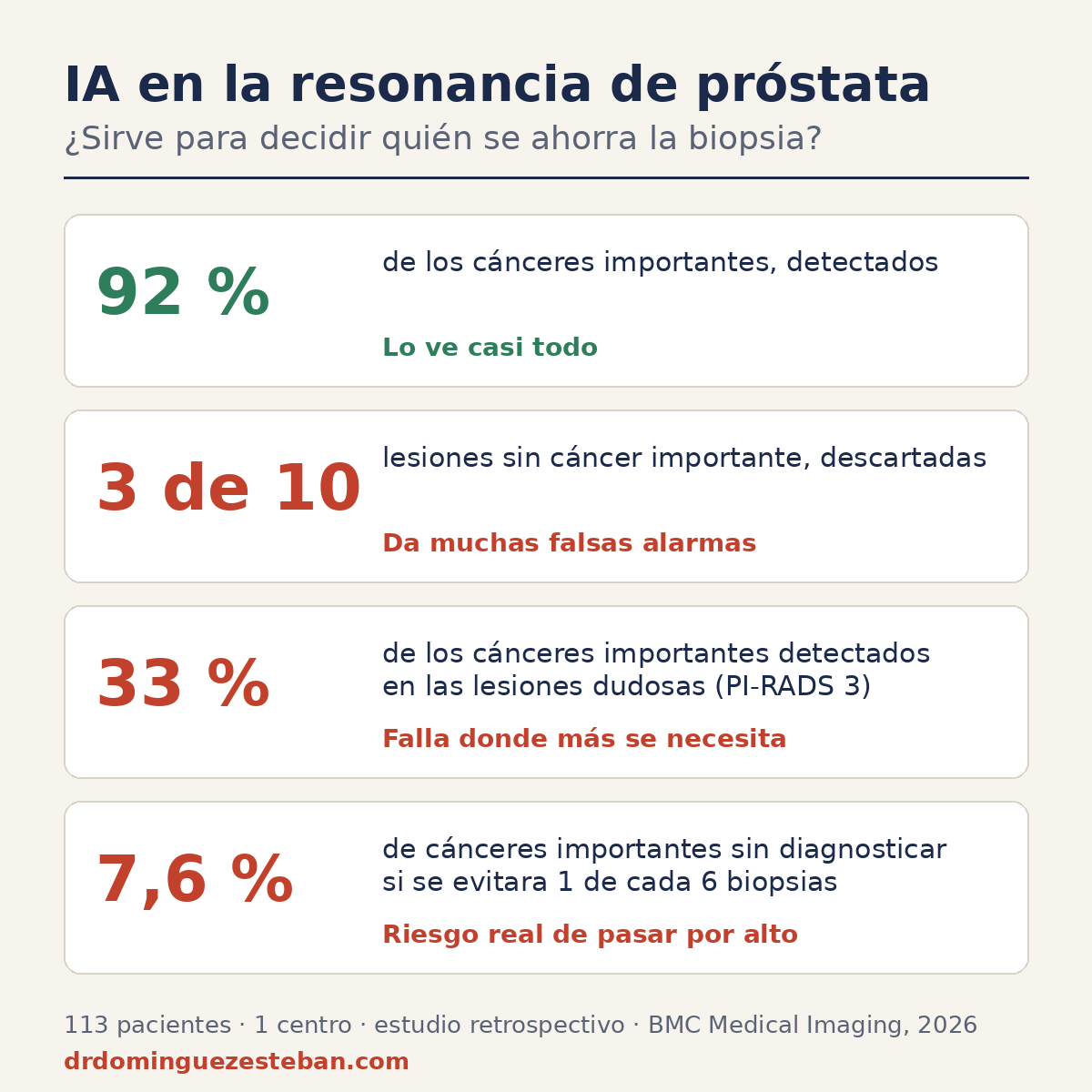
The AI classifies each lesion as low, moderate or high risk. At the “moderate or high” versus “low” cut-off, sensitivity was 0.92 and specificity 0.32. Counting only “high” risk, sensitivity falls to 0.79 and specificity rises to 0.43.
In PI-RADS 3 lesions (the most equivocal: 18 in this study, 3 with significant cancer) AI sensitivity was only 0.33.
The authors simulate what would happen if, with the AI, biopsy were avoided in some cases: 17.7 % of biopsies could be avoided while missing 7.6 % of significant cancers, or 30.1 % avoided while missing 21.2 %.
The study is open access: doi:10.1186/s12880-026-02863-6 ↗.
My reading
AI in prostate MRI can be useful support when reading the images. It does not replace the radiologist or the decision you make with your doctor.
In this study sensitivity is high and specificity is low: the tool picks up many significant cancers, but it also flags as suspicious quite a few lesions that turn out not to be. That limits how many biopsies you can “save” without accepting a risk of missing cancers.
There is spectrum bias to bear in mind: only men with PI-RADS ≥3 entered the study—that is, men in whom suspicion was already raised. That is not the same as using it in everyone who has an MRI.
The study also does not compare head-to-head the AI with reading by an expert radiologist. Without that comparison we do not know whether it adds more, the same or less than usual human reading in each centre.
I have no conflict of interest with Quibim.
If you have been offered an MRI or a biopsy
This article is guidance; it does not diagnose. If you have a high PSA or an MRI with a suspicious area, I explain the usual pathway in High PSA: what it means and what to do and in Prostate fusion biopsy.
A raised PSA is not an emergency. Having a fever or being unable to urinate is: see the warning signs.
Infographic
Visual summary of the study (same clinical reading):
No conflicts of interest with Quibim or with this study. Full declaration: Transparency.
This information does not replace a consultation with your doctor.