Head of the Uro-Oncology Section·Hospital Universitario Marqués de Valdecilla·IDIVAL researcher
Medical registration no. 392860199
Evidence-based urology: clear, reviewed information to help you understand what is happening, decide calmly and ask better questions at your appointment.
Publications39 articles (37 in PubMed) · 1 preprint · 16 book chapters
TrainingH. 12 de Octubre · Memorial Sloan-Kettering · FEBU
i.Evidence firstEvery text cites guidelines and sources.
ii.No exaggerationWhat is known and what is not.
iii.Your privacyThe tools do not store data.
iv.TransparencyConflicts of interest declared.
v.Not a substitute for your doctorGuidance to help you ask better questions.
§ 01 — Questions
What concerns you?
Short answers in plain language, reviewed against current guidelines.
This website does not answer medical questions online. If you have a symptom that worries you, talk to your doctor; if you want an appointment with me, see where I see patients. If your problem cannot wait, seek urgent medical attention (see the warning signs).
11 questionsReviewed Oct 2026
My PSA came back high. Do I have cancer?
+
Not necessarily. PSA can rise because of benign enlargement, inflammation or infection. To avoid false positives, avoid ejaculation, intense cycling and similar activities in the 2–3 days before the test. The usual approach is to repeat it and, if it is still high, to consider an MRI scan before deciding whether a biopsy is needed.
I find it hard to urinate and I get up at night · with video
+
It is usually caused by benign enlargement of the prostate (BPH). Options range from lifestyle changes and medication to surgery, such as HoLEP. Measuring your symptoms helps you explain them at your appointment.
Video in Spanish · 1 min 51 s
Enlarged prostate: what HoLEP is
Why the prostate grows, when surgery is considered and how HoLEP compares with TURP and open surgery.
AI-generated avatar video; script reviewed by Dr. Domínguez Esteban.
Transparency: Dr. Domínguez Esteban acts as a proctor (surgeon trainer) for Boston Scientific (HoLEP or holmium laser enucleation of the prostate, green laser photovaporisation and REZUM) and has declared receiving fees from this company. This video is not sponsored. See all declarations.
Show transcript (English translation)
Do you get up several times at night to urinate? It may be your prostate. And there is treatment.
With age, the prostate grows. It is a benign growth, but it can squeeze the urethra. Then the stream is weak and you go to the toilet more often.
First, lifestyle changes and medication are tried. If that is not enough, surgery is considered.
One option is HoLEP: holmium laser enucleation of the prostate. It is done from inside the urethra, without cuts. The laser separates the tissue that is causing the blockage. It is like scooping the segments out of a mandarin and leaving the peel.
It is a versatile technique: it works for prostates of almost any size.
And compared with transurethral resection of the prostate, or TURP? The strength of the stream improves at least as much. In some studies, slightly more in the first year. And the improvement lasts over the years. There is also less bleeding. And the catheter time and hospital stay are usually shorter.
Compared with open surgery, or simple prostatectomy, the urinary result is similar. But there is less bleeding, and the catheter time and hospital stay are shorter. And, with no cuts, there is no wound that can become infected.
It is a technique that requires experience and specific equipment. That is why it is not available in every centre.
As with TURP, it is common for semen not to come out. This is retrograde ejaculation. Erections do not usually change. In the first few weeks there may be stinging, urgency or some leakage. This usually improves.
Your case decides. It depends on your prostate, your health and what you expect.
Before your appointment, measure your symptoms with the IPSS test at drdominguezesteban.com.
If you see blood in your urine without clots, you can urinate normally and you feel well, it is not usually an emergency, but you should book a priority appointment with your doctor (your family doctor, your urologist or whichever professional you have available), even if it happened only once and does not hurt. Many causes are benign, but others need to be ruled out.
If there are clots, you cannot urinate or you feel faint, seek urgent medical attention.
It depends on the risk of the tumour, your age and your preferences. For low-risk tumours, active surveillance is an established option; in other cases, surgery (including robotic surgery) or radiotherapy is considered. The decision is shared.
Today the standard is cystoscopy together with urine cytology. New urine tests are being researched; they are promising but not yet validated to replace it.
Many kidney masses are found by chance, and not all are malignant. Their size and appearance on CT or MRI indicate whether monitoring is enough or treatment is advisable, often preserving the kidney.
Drinking enough water is the measure with the most weight. Depending on the type of stone, adjustments to salt, animal protein and some foods also help.
Incontinence takes several forms (stress, urgency or mixed) and almost all of them have options, from pelvic floor exercises to specific treatments. It is not something you simply have to accept.
It is common and treatable. Sometimes it is the first sign of a blood vessel problem, so it is worth discussing with your doctor, who will also check your blood pressure, blood sugar and cholesterol.
It can help you organise your questions, but it makes mistakes with apparent confidence and does not know your history. Use it to prepare for your appointment, not to decide on a treatment.
Can I book an appointment or send you my test results?
+
You can book an appointment at my private practice or, through the public health system, with a referral from your family doctor or another specialist: see Where I see patients. This website does not answer medical questions online, and I do not review test results by email or message.
There is no answer for that search yet. Try another word or talk to your doctor. If it is a sudden or severe symptom, check the warning signs.
A raised PSA is a common finding and does not mean you have cancer. Here you will find what PSA is, why it can rise and the steps that usually follow.
Video in Spanish · 55 s · Spanish subtitles
In 1 minute: raised PSA, what it means
What can make PSA rise, how to repeat the test properly and which tests help decide whether a biopsy is needed.
AI-generated avatar video; script reviewed by Dr. Domínguez Esteban.
Show transcript (English translation)
Have you been told your PSA is high? Stay calm. It does not mean you have cancer.
PSA can rise because the prostate grows with age, because of inflammation or a urine infection. And sometimes because of cancer. That is why a single high value is not enough to make a decision.
The usual approach is to repeat it a few weeks later, in the same laboratory. For two or three days beforehand, avoid ejaculation and intense cycling. If you have had a fever or an infection, it is better to wait. If you take finasteride or dutasteride, mention it, because they lower PSA.
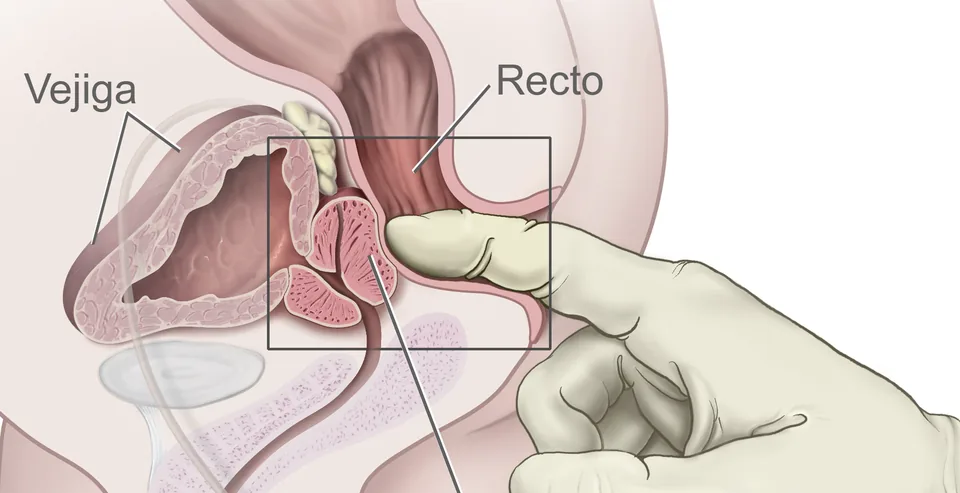
If it is still high, your doctor may examine your prostate with a digital rectal examination. MRI and risk calculators have been shown to help decide whether a biopsy is needed better than PSA alone.
On-screen text at the start: “Dr. Mario Domínguez Esteban. Urologist. Reg. no. 392860199”. At the end: “More information: drdominguezesteban.com. This video is for information only and does not replace a consultation with your doctor”.
What is PSA?
It is a protein made by the prostate and measured with a blood test. A high value means it is worth looking more closely, but on its own it does not tell you what is happening.
Why can it rise?
Because of benign prostatic enlargement (BPH), which is common with age.
Because of inflammation or an infection of the urine or the prostate, especially if there is a fever. It can take months to come down.
Because of urinary retention, a catheter or a recent biopsy.
Because of ejaculation or intense cycling in the 2–3 days before the test.
Sometimes, because of prostate cancer. That is why it is investigated.
Before repeating the test
In the 2–3 days beforehand, avoid ejaculation, intense cycling and similar activities: they can cause a false positive.
If you have had a fever or a urine infection, tell your doctor: it is better to wait.
After a biopsy, PSA is repeated at least one month later.
If you take finasteride or dutasteride, mention it: they lower PSA by roughly half.
Preferably in the same laboratory, so the results can be compared.
And then?
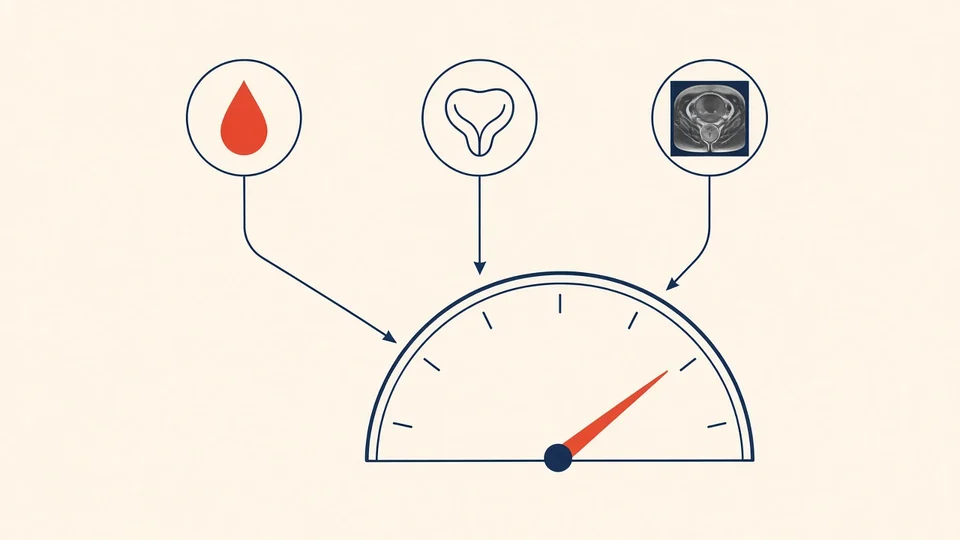
The usual approach is to repeat the test in a few weeks to confirm it is still high, and for your doctor to examine your prostate with a digital rectal examination. With that information, a risk calculator helps estimate the risk. Sometimes a biomarker (an additional blood or urine test, such as PHI) can also help. The next step is usually an MRI scan of the prostate, which helps decide whether a biopsy is needed. Your doctor will also take into account your age, your family history and the size of your prostate.
A raised PSA is not an emergency. Having a fever or being unable to urinate is: see the warning signs.
Visual pathway · 6 steps
Raised PSA pathway
What usually happens after a raised PSA, step by step. Not everyone goes through every step.
Original illustration
Step 1
PSA test
Blood test
A blood test measures PSA. A high value is a signal to look further, not a diagnosis.
The test is repeated, preferably in the same laboratory, to confirm it is still high. For 2–3 days beforehand, avoid ejaculation and intense cycling. Your doctor may also examine your prostate with a digital rectal examination: it is quick and provides information.
Steps 3 and 4: the order can vary. Biomarkers and risk calculators can be used before the MRI, after it or at both points.
Original illustration
Step 3
Biomarkers and risk calculators
Before or after the MRI
A biomarker is an additional blood or urine test, such as PHI. A risk calculator combines your data (age, PSA, rectal examination, prostate size and, if available, the MRI) to estimate the risk.
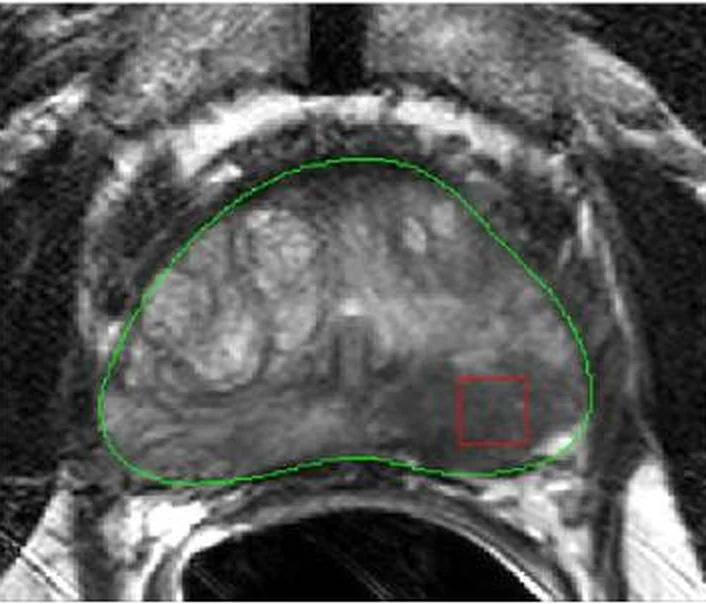
It looks for suspicious areas in the prostate. It helps decide whether a biopsy is needed and, if so, where to take the samples. Its result can be added to a risk calculator.
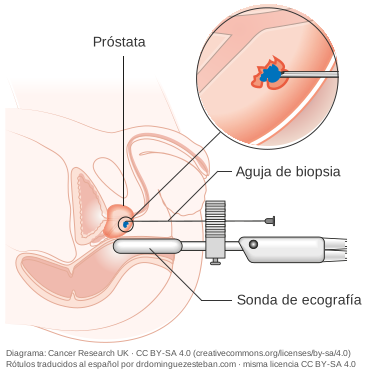
The MRI is combined with ultrasound, which may be high-resolution micro-ultrasound, to guide the samples to the suspicious area. This improves detection of cancers that need treatment. The transperineal route, through the skin of the perineum, carries a lower risk of urinary infection. It is the option in line with the European guidelines.
With the results, you and your urologist decide on the next steps: follow-up with further tests, more investigations or treatment. Bring your questions written down.
Why combine steps?
MRI and risk calculators, including those that incorporate the MRI result, have been shown to improve the decision on whether to perform a biopsy compared with PSA or rectal examination alone. They help avoid unnecessary biopsies while still detecting the cancers that matter.
Biomarkers such as PHI may help in some cases. The European guidelines consider that their value is still being confirmed.
Original illustrations generated with AI and reviewed by Dr. Domínguez Esteban.
Video in Spanish · 1 min 37 s · Spanish subtitles
Prostate biopsy: how it is done today
MRI first; if there is a suspicious area, a fusion biopsy targeted at that area and by the transperineal route, with a lower risk of infection.
AI-generated avatar video; script reviewed by Dr. Domínguez Esteban.
Show transcript (English translation)
Have you been offered a prostate biopsy? Today it is done differently from a few years ago.
In the past, samples were taken from all over the prostate, without really knowing where to look. And almost always through the rectum.
Today, the usual approach is to start with an MRI scan. The MRI shows whether there is a suspicious area. If there is not, the biopsy can sometimes be avoided.
If there is a suspicious area, a fusion biopsy is performed. The MRI images are overlaid on the live ultrasound. This way the needle is guided to that area. Usually some samples are also taken from the rest of the prostate.
Where does the needle go in? The European guidelines recommend the transperineal route. The needle goes in through the skin between the scrotum and the anus, not through the rectum. This means a lower risk of infection. And, if you have no risk factors, antibiotics are often not needed.
It is often done under general anaesthetic or deep sedation. That way you do not move, and the image fusion is precise. It is also more comfortable for you. Local anaesthetic is also given so that you have less discomfort afterwards.
In the following days you may notice blood in your urine or semen. This is common. If you have a fever or cannot urinate, seek urgent medical attention.
At drdominguezesteban.com you will find the raised PSA pathway, with this step explained.
§ 03 — Tools
Easy tests and tools
For guidance, not diagnosis
They run in your browser, take less than five minutes and need no registration. We do not store your answers. The result is for talking to your doctor, not for replacing them.
Video in Spanish · 1 min 47 s · Spanish subtitles
Three questionnaires to explain your symptoms
What the IPSS, the IIEF-5 and the ICIQ-SF measure, and why they provide guidance but not a diagnosis.
AI-generated avatar video; script reviewed by Dr. Domínguez Esteban.
For now only the IPSS is available; the IIEF-5 will be added once we have the licence to use it, and the ICIQ-SF can be consulted on its official website.
Show transcript (English translation)
Three short questionnaires help you explain what is happening to you. But they do not give you a diagnosis.
At an appointment, it can be hard to put symptoms into words. That is why we use validated questionnaires. They are the same in many countries and make it possible to measure and compare.
The IPSS measures urinary symptoms: a weak stream, going often, getting up at night. It ranges from 0 to 35 points. The higher the score, the more symptoms. It adds one question on how they affect your life.
The IIEF-5 asks about erections over the last six months. It ranges from 5 to 25. A low score suggests erectile dysfunction, but it does not explain the cause.
The ICIQ-SF measures urine leakage: how often, how much and how much it bothers you. It ranges from 0 to 21.
Now the important part: these questionnaires provide guidance; they do not diagnose. The same symptoms can have different causes. A high IPSS score does not tell you whether the problem is the prostate, the bladder or something else. For that you need an appointment, an examination and sometimes tests.
Where they do help is in bringing your symptoms to the appointment in an organised way. And in seeing whether a treatment is working for you, if you repeat them over time.
If you have a fever, cannot urinate or see blood, do not fill in a questionnaire: seek medical advice.
You can complete them at drdominguezesteban.com in less than five minutes. We do not store your answers. Print the result and take it to your doctor.
Tick anything that appliesIf you tick nothing and you feel well, there is no warning sign from this list.
For guidance, not diagnosis
Video in Spanish · 1 min 50 s
Warning signs in urology
Which symptoms should be assessed urgently and which call for a priority appointment with your doctor.
AI-generated avatar video; script reviewed by Dr. Domínguez Esteban.
Show transcript (English translation)
Some urological symptoms cannot wait until your next appointment. Here are the ones.
You should seek urgent medical attention if you cannot urinate at all, even though you really need to. If you have a fever with pain in your side or back. If you have a fever with stinging or difficulty when urinating. Or if you have a fever and have a urinary catheter or a double-J stent.
Also if you notice sudden, severe pain in a testicle. Here time matters: do not wait to see if it goes away. If you have colic that does not settle with your painkiller, with fever, or if you have only one kidney. Or an erection that lasts more than four hours.
And if you see blood in your urine with clots, if you cannot urinate or after an injury. Or if you notice pain, redness or swelling spreading quickly in the genitals or perineum, with or without fever.
In any of these cases, do not wait to see if it goes away: seek urgent medical attention.
Other signs are not an emergency, but they do call for a priority appointment with your doctor: your family doctor, your urologist or whichever professional you have available. Blood in the urine without clots, if you can urinate normally and feel well, even if it happened only once. A painless lump or hardening in a testicle. Or being told that your PSA is high.
If things get worse or anything from the first list appears, seek urgent medical attention. And do not take antibiotics on your own.
At drdominguezesteban.com you will find this list of warning signs to check whenever you need it.
External linksOpen on another website ↗
Prostate risk calculators
Tools from research groups to use with your doctor: they estimate a risk; they do not diagnose.
Nature Medicine, 2 Oct 2026. Study with 683 urine samples from patients and controls: 95% sensitivity with 90% specificity in localised tumours; it outperformed cytology. It needs prospective validation in several centres before it can be used in practice.
Expectation meter3 / 5
CautionHype
What changes today: nothing yet. Prospective validation is still needed; the standard remains cystoscopy and cytology.
List checked by hand against my CV and PubMed. Each article links to PubMed or, if it is not indexed, to the journal. Titles are shown in their original language.
García-Formoso N, …, Domínguez Esteban M, …, Gutiérrez Baños JLTrasplante renal en pacientes testigos de Jehová: revisión de complicaciones de la serie histórica de un centro de referencia nacionalAcademic Journal of Health Sciences · 2024
I am a urologist in Santander. I work as Head of the Uro-Oncology Section at Hospital Universitario Marqués de Valdecilla and carry out research at IDIVAL.
My work focuses on urological cancer (prostate, bladder, kidney), robotic surgery, BPH and kidney transplantation. In 2018 I introduced HoLEP at Valdecilla, and since 2015 I have directed the green laser courses at Hospital Virtual Valdecilla. I take part as an investigator in clinical trials and in projects on artificial intelligence applied to medicine.
As a urology resident tutor (Tutor MIR), teaching is part of my everyday work. This portal comes from the same idea: explaining things well so that decisions are better informed.
Degree in Medicine, Universidad Complutense de Madrid (1999–2005).
Specialist in Urology (MIR residency), Hospital Universitario 12 de Octubre, Madrid (2006–2011).
Observer fellowship in uro-oncology and minimally invasive surgery, Memorial Sloan-Kettering Cancer Center, New York (2010).
Diploma of Advanced Studies (DEA), Universidad Complutense de Madrid (2011).
Fellow of the European Board of Urology (FEBU), 2012.
University Expert in Advanced Urological Surgery, Universidad Europea de Valencia (2018–2019).
Master's degree in Advanced Prostate Cancer, Universidad de Salamanca (2018–2019).
Master's degree in Comprehensive Medical and Surgical Management of Localised, Advanced and Metastatic Kidney Cancer, AEU–Universidad de Salamanca (2022).
Continuing Education Master's degree in Health Services Management, Universidad de Cantabria (2023–2024).
Expert in Advanced Use of AI in Health Sciences Teaching, Universitat de Barcelona (2025–2026).
Master's degree in Artificial Intelligence Applied to Health, Founderz, with Founderz and Microsoft certification.
PhD candidate in Medicine at the Universidad de Cantabria: thesis on the PHI index and MRI in the diagnosis of prostate cancer, submitted and pending defence.
§ 07 — Clinics
Where I see patients
I see patients in two places in Santander: in private practice, at Urología Mínimamente Invasiva, and in the Spanish public health system, at Hospital Universitario Marqués de Valdecilla. This website does not answer medical questions online; here is how to book an appointment in each case.
Private practiceUrología Mínimamente Invasiva
My private practice is only at Urología Mínimamente Invasiva, in Santander.
Address
C/ Juan de Herrera 20, 1º B 39002 Santander (Cantabria, Spain)
Public health systemHospital Universitario Marqués de Valdecilla
I work as Head of the Uro-Oncology Section in the Urology Department at Hospital Universitario Marqués de Valdecilla, in Santander.
The hospital's Urology outpatient clinic is accessed through the public health system, with a referral from your family doctor or another specialist. I cannot give or bring forward hospital appointments through this website.
Profile cardCard
Uro-oncology
Dr. Mario Domínguez Esteban has been Head of the Uro-Oncology Section at Hospital Universitario Marqués de Valdecilla, in Santander, since April 2024. His work focuses on prostate cancer at all stages, from diagnosis to metastatic disease, and also on bladder and kidney tumours. At Valdecilla he is responsible for the Uro-oncology clinic, which has cared for patients with metastatic prostate cancer since 2015, and he has been part of the Pelvic Oncology Unit, dedicated to prostate cancer and muscle-invasive bladder cancer, since it was created in October 2019. He decides each patient's treatment together with oncologists, radiation oncologists and other specialists. He is a member of the IDIVAL Medical Oncology research group. He trained at Hospital 12 de Octubre in Madrid and at Memorial Sloan-Kettering Cancer Center in New York.
Key facts · Uro-oncology
Head of the Uro-Oncology Section at HUMV since April 2024.
Fellow of the European Board of Urology (FEBU), 2012.
Master's degree in Advanced Prostate Cancer (2018–2019) and Master's degree in Kidney Cancer (2022), Universidad de Salamanca.
Member of the HUMV CSUR (national reference unit) team for kidney cancer with venous thrombus (since 2017).
Member of the scientific committee of the GUARD genitourinary tumours group.
Years of experience in fusion biopsy with high-resolution micro-ultrasound (ExactVu) and in reading prostate MRI, with an EAU-certified training course.
HoLEP (holmium laser enucleation of the prostate)
HoLEP is an endoscopic technique that treats benign enlargement of the prostate (benign prostatic hyperplasia) without skin incisions. A holmium laser is used to separate and remove the tissue that obstructs the outflow of urine. Dr. Domínguez Esteban introduced HoLEP at Hospital Universitario Marqués de Valdecilla in 2018 and has performed more than 500 procedures over the course of his career. At the hospital he also coordinates green laser photovaporisation and outpatient water vapour treatment (REZUM), both of which he introduced himself. Since 2015 he has directed and taught green laser courses at Hospital Virtual Valdecilla and, as a proctor, trains other urologists in these techniques. The choice of technique depends on each patient and is decided in clinic.
Key facts · HoLEP
Introduced HoLEP at HUMV in 2018.
More than 500 HoLEP procedures over the course of his career.
Proctor for Boston Scientific in holmium laser enucleation, green laser photovaporisation and REZUM.
Director and instructor of the green laser photovaporisation courses at Hospital Virtual Valdecilla since May 2015.
Robotic surgery
Robotic surgery makes it possible to operate through small incisions. From a console, the surgeon controls robotic arms with magnified three-dimensional vision. Dr. Domínguez Esteban is a member of the advisory group on robotic surgery of the Management (Dirección-Gerencia) of Hospital Universitario Marqués de Valdecilla. He was certified on the da Vinci Si system in 2011 and on the da Vinci Xi in 2016. He has performed more than 400 robotic procedures as primary surgeon, and more than 1,000 if those in which he took part as assistant are included. He uses this approach mainly in radical prostatectomy, radical cystectomy and partial nephrectomy, and has worked with 3D models to plan kidney surgery. He also trains other surgeons as a proctor for Intuitive, the company that manufactures the da Vinci system.
Key facts · Robotic surgery
More than 400 robotic procedures as primary surgeon and more than 1,000 including those in which he assisted.
da Vinci Si certification (November 2011) and da Vinci Xi certification (January 2016).
Robotic surgery proctor for Intuitive.
AEU Technological Innovation Award (2019), as co-author, for the use of 3D models in robotic renal tumorectomy.
Video in Spanish · 1 min 52 s
Robotic surgery: what it is and what it offers
What robotic surgery is, what it is used for in urology and what studies show compared with open surgery.
AI-generated avatar video; script reviewed by Dr. Domínguez Esteban.
Transparency: Dr. Domínguez Esteban acts as a proctor (surgeon trainer) for Intuitive (robotic surgery) and has declared receiving fees from this company. This video is not sponsored. See all declarations.
Show transcript (English translation)
Have you been offered robotic surgery? Let me tell you what it is.
First of all: the robot does not operate on its own. Your surgeon controls it from a console, in the operating theatre. Everything is done through small incisions.
What does it offer? Magnified, three-dimensional vision. The system filters out hand tremor. And the instruments rotate like a wrist. This makes movements more precise.
In urology, it is used to operate on tumours. For example, to remove the prostate or the bladder. Or to remove a tumour and preserve the kidney.
Also in reconstructive surgery. For example, a narrowing between the kidney and the ureter. Or a ureter that needs to be reconnected to the bladder. And genital prolapse in women.
What do studies show? Compared with open surgery, cancer control is similar. There is usually less bleeding and a shorter hospital stay.
And continence and erections after removing the prostate? Some studies show that they recover sooner. Others, after one or two years, find no differences. In reconstructive surgery, success rates are similar with other techniques.
I train other surgeons in robotic surgery. The robot is a tool. The result depends above all on the experience of the team. In expert hands, it is now one of the main minimally invasive options.
It is not available in every hospital. It requires specific training for the whole team. And not every case is suitable for the robot.
If you are offered surgery, talk to your urologist. Ask what options you have and what experience the team has.
Kidney transplantation
Kidney transplantation is the indicated treatment for many patients with advanced kidney failure. Dr. Domínguez Esteban has been dedicated to kidney transplantation for more than 20 years and is part of the Urology Department of Hospital Universitario Marqués de Valdecilla, which has a transplant programme. He has researched and published on surgical aspects of transplantation: third, fourth and fifth transplants and their complications, transplantation in patients who are Jehovah's Witnesses, tumours that appear in the transplanted kidney and transplant activity during the COVID-19 pandemic. During his training at Hospital 12 de Octubre in Madrid he took part in studies on combined kidney–pancreas transplantation and on third kidney transplants.
Key facts · Kidney transplantation
More than 20 years dedicated to kidney transplantation.
Co-author of publications on kidney transplantation in Archivos Españoles de Urología, Actas Urológicas Españolas and Transplantation Proceedings.
Pérez Castro Award (first runner-up, 2018) for an article on third, fourth and fifth kidney transplants.
AI in medicine and research
Dr. Domínguez Esteban applies artificial intelligence (AI) to prostate cancer care. He is the principal investigator and developer of the SAICaP Project, which in 2026 was awarded a national healthcare quality grant. The project sets up digital follow-up at Valdecilla for patients with advanced prostate cancer: the patient answers short questionnaires on symptoms, side effects and quality of life, and a system of explainable clinical rules alerts the team to cases that need attention sooner. It does not replace the doctor's assessment. Its technical basis is SEGUIA-CAP, his final project at the Universitat de Barcelona. He coordinates the Artificial Intelligence Working Group of GUARD Consortium and has taken part in the CAP-IA 6M study, which uses AI to analyse the use of six-monthly hormone treatments in Spain.
Key facts · AI in medicine and research
Principal investigator and developer of the SAICaP Project (5th edition of the Bayer Hispania Healthcare Quality Grants in Prostate Cancer, 2026; managed by IDIVAL).
Training in AI: Expert in Advanced Use of AI in Health Sciences Teaching (Universitat de Barcelona, 2025–2026; final project SEGUIA-CAP) and Master's degree in Artificial Intelligence Applied to Health (Founderz, with Founderz and Microsoft certification).
Coordinator of the GUARD Consortium AI Working Group; talk "Early detection with AI" at the GUARD Symposium (Madrid, 17 September 2026).
First author of the CAP-IA 6M study presentation (sponsor: Ipsen) at the National Meeting of the Uro-Oncology Group (Gijón, April 2025).
Teaching · Resident tutor
Training new specialists is a constant part of his work. Since June 2019 he has been a Urology resident tutor at Hospital Universitario Marqués de Valdecilla, where he supports MIR residents during their training. Since 2011 he has been an associate lecturer (profesor colaborador) in the Department of Surgery (Urology Section) at the Universidad de Cantabria. He is an instructor at Hospital Virtual Valdecilla, the hospital's simulation centre, on courses in laparoscopy, prostate laser and REZUM, and has directed the green laser courses since 2015. He has coordinated online prostate cancer courses for residents since 2017 and has taught on national courses of the Asociación Española de Urología, such as Rising Stars. He is responsible for the department's clinical sessions.
Key facts · Teaching · Resident tutor
Urology resident tutor at HUMV since June 2019.
Associate lecturer at the Universidad de Cantabria since July 2011.
HUMV–Caja Cantabria Teaching Excellence Award (2016) for a project to train residents in laparoscopic surgery.
Director of the green laser courses at Hospital Virtual Valdecilla (since 2015) and coordinator of online prostate cancer courses (2017–2020).
Reviewer for Actas Urológicas Españolas, Archivos Españoles de Urología and BMC Urology.
Research and clinical trials
Dr. Domínguez Esteban is an active researcher. He is a member of the Medical Oncology research group of the Instituto de Investigación Marqués de Valdecilla (IDIVAL) and has ongoing academic studies and clinical trials on prostate cancer, bladder cancer and artificial intelligence. At Valdecilla he takes part in trials evaluating new treatments, such as therapies given inside the bladder or hormonal drugs for prostate cancer, and in real-world clinical practice registries, such as PROHNOS, of which he is co-principal investigator. He has been principal investigator of his own studies on hormone treatment and on the GLUT4 transporter in prostate cancer, and co-principal investigator of two studies on indocyanine green in robotic surgery. Taking part in a study is voluntary and depends on each study's criteria. He is a member of the scientific committee of the GUARD group.
Key facts · Research and clinical trials
Member of the IDIVAL Medical Oncology group (Cancer Area).
Principal investigator of two studies approved in 2017 (hormone treatment; GLUT4) and co-principal investigator of two studies with indocyanine green (2021).
Trials open to recruitment: SURF302, ABLE-22, ABLE-32 and ROAD.
In follow-up: LEGEND, SunRISe-2, -3, -4 and -5, PROTEUS and DAROL. Observational: RING, PROHNOS (co-principal investigator), REAL-STAMPEDE and EMBARCHES (being set up).
39 articles (37 indexed in PubMed), 1 preprint, 16 book chapters and more than 200 conference presentations.
First author of the PHI + MRI model (BJUI Compass, 2025). The thesis is pending defence and has been formally deposited at the Doctoral School.